My Blog List

Monday, November 29, 2021

Language, learning, identity, privilege

 Language, learning, identity, privilege


By JAMES SORIANO
August 24, 2011, 4:06am


MANILA, Philippines — English is the language of learning. I’ve known this since before I could go to school. As a toddler, my first study materials were a set of flashcards that my mother used to teach me the English alphabet.


My mother made home conducive to learning English: all my storybooks and coloring books were in English, and so were the cartoons I watched and the music I listened to. She required me to speak English at home. She even hired tutors to help me learn to read and write in English.


In school, I learned to think in English. We used English to learn about numbers, equations, and variables. With it, we learned about observation and inference, the moon and the stars, monsoons, and photosynthesis. With it, we learned about shapes and colors, about meter and rhythm. I learned about God in English, and I prayed to Him in English.


Filipino, on the other hand, was always the ‘other’ subject — almost a special subject like PE or Home Economics, except that it was graded the same way as Science, Math, Religion, and English. My classmates and I used to complain about Filipino all the time. Filipino was a chore, like washing the dishes; it was not the language of learning. It was the language we used to speak to the people who washed our dishes.


We used to think learning Filipino was important because it was practical: Filipino was the language of the world outside the classroom. It was the language of the streets: it was how you spoke to the tindera when you went to the tindahan, what you used to tell your katulong that you had an utos, and how you texted manong when you needed “sundo na.”


These skills were required to survive in the outside world because we are forced to relate with the tinderas and the manongs and the katulongs of this world. If we wanted to communicate to these people — or otherwise avoid being mugged on the jeepney — we needed to learn Filipino.

That being said though, I was proud of my proficiency with the language. Filipino was the language I used to speak with my cousins and uncles and grandparents in the province, so I never had much trouble reciting.


It was the reading and writing that were tedious and difficult. I spoke Filipino, but only when I was in a different world like the streets or the province; it did not come naturally to me. English was more natural; I read, wrote, and thought in English. And so, in much of the same way that I learned German, later on, I learned Filipino in terms of English. In this way, I survived Filipino in high school, albeit with too many sentences that had the preposition ‘ay.’

It was really only in university that I began to grasp Filipino in terms of language and not just dialect. Filipino was not merely a peculiar variety of language, derived and continuously borrowing from the English and Spanish alphabets; it was its own system, with its own grammar, semantics, sounds, even symbols.


But more significantly, it was its own way of reading, writing, and thinking. There are ideas and concepts unique to Filipino that can never be translated into another. Try translating bayanihan, tagay, kilig or diskarte.


Only recently have I begun to grasp Filipino as the language of identity: the language of emotion, experience, and even of learning. And with this comes the realization that I do, in fact, smell worse than a malansang isda. My own language is foreign to me: I speak, think, read and write primarily in English. To borrow the terminology of Fr. Bulatao, I am a split-level Filipino.


But perhaps this is not so bad in a society of rotten beef and stinking fish. For while Filipino may be the language of identity, it is the language of the streets. It m
ight have the capacity to be the language of learning, but it is not the language of the learned.

It is neither the language of the classroom and the laboratory, nor the language of the boardroom, the courtroom, or the operating room. It is not the language of privilege. I may be disconnected from my being Filipino, but with a tongue of privilege, I will always have my connections.


So I have my education to thank for making English my mother language.


----------------------------------------------------------------------------------------------------------------------------


Answer the following questions: 

1. Why do you think the article is entitled ''Language, learning, identify, privilege?''

2. How was the English Language described in the article?

3. Why do you think the author regards Filipino as the language of the streets and English as the language of the learned? Cite the author's reasons for coming with such conclusions.

4. Do you agree with the assertions made in the article about the Filipino language? Explain.

5. Why did the writer describe himself as worse than a ''malansang isda'' and a split-level Filipino?

6. Why do you think he considers English as his mother language?

7. Do you also consider English as your mother language? Why or why not?

8. Does the writer make a strong about the issue presented? How did he convince the reader to believe in his claims? 


Tuesday, September 7, 2021

Proofread Your Thesis

Proofread your thesis

    After you have finished your thesis, you will need to proofread it (multiple times) before you can present it to your committee. You have put a lot of work into your thesis, and you do not want an otherwise excellent work to fail because of grammar mistakes and typos. Also, catching our own typos and mistakes is so much harder than doing it with other people's writings. This is why this crucial part of your thesis can be the most challenging one. We have put together a few tips that can help you when proofreading your thesis.


1. Review your institution's guidelines

Before you have even started writing your thesis, you have most likely made yourself familiar with your institution's rules and guidelines on the format and style of your thesis. Make sure you double check the guidelines for the general layout including:

  • paper size and margins
  • running head
  • page numbering
  • line spacing
  • title page

    You might be following the Harvard, APA (American Psychological Association), MLA (Modern Language Association) or some other citation style. Take time to read through the guidelines again and keep them in the back of your mind when reviewing and proofreading your thesis.

2. Take a break before you read anything

    This is probably our most important piece of advice. Give yourself some time before you start proofreading your thesis. It would be best if you could stay away from it for a couple of weeks and then come back to it. Taking some space from your thesis will give you time to clear your mind and approach it from a fresh perspective when you come back to it. You will be able to see things you did not see before.

3. Determine your proofreading method

    Some people like to proofread their thesis on screen, others like to print it out and read it on paper. Whichever method you choose, be aware that you can't read it all at once, so while you're still in the planning process, make a realistic plan of which parts to read when and how much to read at a time.

4. Use online tools

    There are some online software tools out there that can greatly help you with your proofreading work. Some of them are even free. You can use tools like Grammarly or Proofread Bot for proofreading or Readable.com or Slickwrite to critique your grammar and writing. A quick Google search will show you that there are dozens of (better or worse) tools out there that can help you with your thesis!

5. Read your thesis in a different order

    Read your work backward or in a random order. Supposedly, this works better than reading it through from the beginning, as your brain knows what you meant to write, so you tend to skip over errors when reading forwards.

6. Read your thesis out loud

    Read your work aloud to yourself. This way you'll have to read each word individually in a slower pace, which will increase your chances to find typos and errors.

7. Reach out to your peers

    As an additional piece of advice, Pat Thomson suggests in her blog to set up a proofreading deal with a friend. Two heads are better than one and you can help each other to find typos and grammar mistakes.

Thursday, September 2, 2021

Context clues and Word Structure


Structure of a Specific Academic Text/Reading and Analyzing Academic Text

Hello, learners. In this session we will be discussing the four macro skills and the two categories of language skills : 

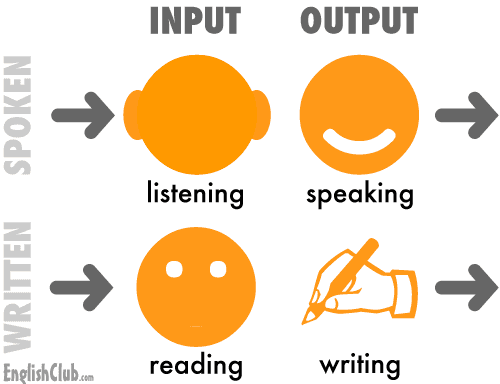
When we learn a language, there are four skills that we need for complete communication. When we learn our native language, we usually learn to listen first, then to speak, then to read, and finally to write. These are called the four "language skills":


The 4 language skills


The four macro skills 

The four language skills are related to each other in two ways:

  • the direction of communication (in or out)
  • the method of communication (spoken or written)
Input is sometimes called "reception" and output is sometimes called "production". Spoken is also known as "oral".

Note that these four language skills are sometimes called the "macro-skills". This is in contrast to the "micro-skills", which are things like grammar, vocabulary and pronunciation.

A. LISTENING- is receiving language through the ears. Listening involves identifying the sounds of speech and processing them into words and sentences.

The Art of Listening (+5 Tips To Help You Master It )

B. SPEAKING- is the delivery of language through the mouth. To speak, we create sounds using many parts of our body, including the lungs, vocal tract, vocal chords, tongue, teeth and lips.

ESL Speaking Lesson Plan Template | Teaching English Conversation

C. READING- is the process of looking at a series of written symbols and getting meaning from them.

Shake up your Shelf Life with The Penguin Reading Challenge 2020 ...

D. WRITING- is the process of using symbols (letters of the alphabet, punctuation and spaces) to communicate thoughts and ideas in a readable form.

Is Hiring a Writer for Your Small Business Worth the Money? - Wave ...

TWO CATEGORIES OF LANGUAGE SKILLS

RECEPTIVE SKILLS

-has something to do with how you interpret what your senses received.

PRODUCTIVE SKILLS

-allow you to produce something that you want to communicate to others.

Listening

Writing

Reading


ANALYZING ACADEMIC TEXT

TWO STRATEGIES

1. Using Context Clues

2. Analyzing word structure

=================================================================================

1. USING CONTEXT CLUES

I. Context Clues

•          are the words or sentences surrounding the unfamiliar word that give hints on its meaning

•          used to guess the meaning of an unfamiliar word; a strategy to improves one's reading skill.


Example:

Piscatorial creatures, such as lounder, salmon, and trout, live in the coldest parts of the ocean.

“Piscatorial” obviously refers to fish.

The lugubrious wails of the gypsies matched the dreary whistling of the wind in the all but-deserted cemetery.

“Lugubrious” which means sorrowful, fits into the mood set by the words “wails,” “dreary”, and “deserted cemetery.”


II. Synonym or Definition Clues

•          the meaning of an unfamiliar word is given in the sentence if a similar word is also used to make the meaning clearer.

•          Signal words for synonym clues are or, in other words, that is, by this we mean, that is to say, and also known as.


Example:

Caught in an epiphany, that is, a sudden, strong, and clear realization, I suddenly knew how to solve my dilemma.

The word epiphany is defined as “a sudden, strong and clear realization” with the signal word “that is” as a hint.


III. Antonym or Contrast Clues

•          the meaning of an unfamiliar word is given in the sentence if an opposite word is used to suggest the meaning.

•          Signal words for antonym clues are but, however, on the other hand, nevertheless, yet, and ij contrast.


Example:

Jogging long distance exacerbates the pain in my feet. However, soaking my feet in warm water after jogging feels relaxing and soothing.

Exacerbates means “to aggravate” or “increase the pain”; the signal word however signifies opposite.


IV. General Clues

•          making sense of a word's meaning by largely depending on your common sense requires you to use your knowledge and experience.


Example:

Paul knew he just made a cultural faux pas when he kissed the Muslim woman on the cheek and he was met with a dead, stunned stare.

(If you have a prior knowledge about the Muslim culture, you would know that it is conservative in the sense that there should be no physical contact between people of the opposite gender.)

Faux Pas refers to committing a mistake or an unacceptable action.

Dead, stunned stare is an indicator that the action of kissing is not acceptable based on your prior knowledge and that this expression is a mark of displeased behavior or reaction.


2. WORD STRUCTURE

•     composed of three parts

a. Prefix

b. Root word

c. Suffix

Example:

Unisolated

Un (prefix) isolate (root word) -ed (suffix)

•          the parts of a word in English have meanings based on their origin, which could be Latin, Greek, and French, to name a few.

PREFIX

      -    are letters which we add to the beginning of a word to make a new word with a different meaning

–        to attach before a word

–        Pre means “before” fix “to attach”

–        there are negative prefixes such as un-, non-, on-, and dis-

–        show location such as tele-, sub-, and trans-

–        show numbers or amounts such as mono-, bi-, multi-, and deca-

Examples:

NEGATIVE WORDS

WORDS THAT TELL LOCATION

WORDS THAT CONNOTE NUMBERS

Unhappy, Nonfact, incorrect

Subterranean, international, transatlantic

Monolingual, bicycle, multifaceted, decagon


 SUFFIX

–        usually change a word from one form or part of speech (e.g., noun, verb, and adjective) to another form.

–        A verb can become a noun when you add suffix

Example:

memory-nour

memorable-verb


NOUN SUFFIXES

VERB SUFFIXES

ADJECTIVE SUFFIXES

-ance, -dom, -hood, -ity, -ive, -ment, -ness, -ship, -tion, -tude, -er, -ist

-ize, -ify, -ate, -en

-ful, -ious, -ous, -ate, -y, al, ic, ish, ive, -able, -ible, -less, -ed


F. Root Word

•          root word in modern English are easy to spot.

Examples:

Aimless- aim

Unloved- loved

Joyful- joy

•          however, many root words in English that originated from Latin, Greek and other languages are difficult to spot.

G. Denotation

•          refers to the real meaning of a word.

Example:

Snake- is “betrayal, evil, or danger”


I. Connotation 

•  refers to implied meaning


Example: 

''This heart of mine is yours now and forever.'' 

                  (Does one really take out his or her heart and give it to someone else?) 


Speaking


EXPRESS YOUR PERSPECTIVE!

  WRITE YOUR POSITION PAPER FOLLOWING THESE STEPS. POST YOUR POSITION PAPER ON THE COMMENT SECTION.  1. Choose a Topic: Select a specific a...